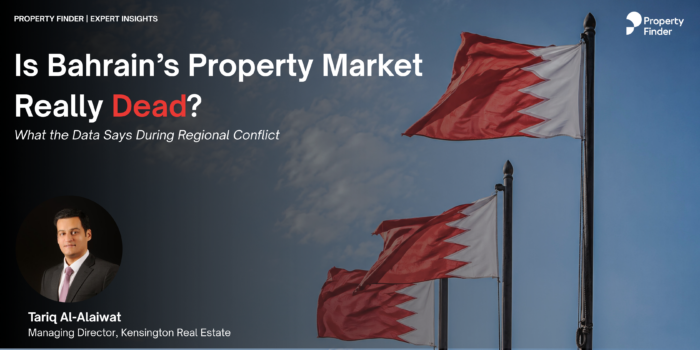
Over the past 5 months, I have heard the same comment from buyers, sellers and even people in the industry: “The property market is dead.”
I understand why it feels that way. The regional conflict has made buyers more cautious. Decisions are taking longer and transactions that might once have moved quickly are being put on hold. But a market that is dead and a market where buyers have lost their urgency are two very different things.
From what I am seeing, and from the transaction numbers, Bahrain looks much more like the latter.
The Slowdown Is Real
There is no point pretending the regional situation has had no effect. It has.
When conflict escalates close to home, buying a property naturally becomes less urgent. Someone who was ready to spend BD150,000 may decide that waiting 6-12 months costs very little while giving them time to see how things develop.
That reaction is understandable. Property is a large and illiquid purchase, and uncertainty makes people more protective of cash and more reluctant to make quick decisions.
On the ground, we feel it through fewer enquiries, longer negotiations and buyers who were previously ready to proceed now saying, “Let me wait and see.” But that is not the same as demand disappearing.
What Does the Data Actually Tell Us?
According to property transaction data published by Bahrain’s Survey & Land Registration Bureau (SLRB), there were 5,038 property sale transactions worth approximately BD671 million in the first half of 2026.
The monthly numbers are even more interesting. March, when regional tensions intensified, recorded only 339 property sales. In April, however, transactions rebounded to 1,129 – the strongest month of the first half. January recorded 933 sales, February 923, May 770 and June 857.
Those figures do not support the idea that nobody is buying. They show a market that is sensitive to confidence and uncertainty.
It is also worth remembering that transaction numbers, prices, enquiry levels and total transaction values are not the same thing. A quiet month for an individual agent does not necessarily mean the whole market has stopped, just as a busy month does not automatically mean prices are rising.
Uncertainty Changes Buyer Behaviour
One lesson from investment markets applies particularly well here: people find it easier to make decisions when they understand the risk. When they do not know what happens next, waiting becomes attractive.
A buyer may be thinking: Will the conflict escalate? Could prices fall? Will sellers become more flexible? Why buy today if I might negotiate a better deal in three months?
That last question has a real effect on the market. A buyer can often afford to wait. A motivated seller may not have the same luxury.
When enough buyers think this way at the same time, negotiating power starts to shift. That does not necessarily lead to a sudden fall in advertised prices. More often, properties remain on the market longer, sellers become more receptive to offers, developers improve incentives and overpriced stock simply sits.
Does That Make This a Buyer’s Market?
In parts of the market, perhaps. But I would be very careful with the assumption that uncertainty automatically creates bargains.
A bad property at a 5% discount is still a bad investment.
Whether the market is strong or weak, I still want to understand tenant demand, service and maintenance costs, competing supply, realistic resale prospects and the price I am being asked to pay.
Sellers also have to recognise when the market is giving them information. If a property has been properly exposed for months, receives viewings and repeatedly attracts offers around the same level, it may be worth considering whether the issue is the buyers or the asking price.
Could the War Cause More Serious Problems?
Of course it could. It would be irresponsible to suggest otherwise.
A prolonged regional conflict can affect confidence, tourism, aviation, business investment, employment and the willingness of both local and international investors to commit money. If those effects become significant enough, they can eventually feed through to rents and property values.
My response would not be to ignore the war; it would be to price the additional risk.
If an investor was happy to pay BD150,000 for a property before the conflict, does the same price make sense today? It might. But increased uncertainty may also mean that investor should demand a better entry price, a stronger yield or a larger margin of safety.
That, to me, is a more useful question than trying to label the present as either a “good” or “bad” time to buy.
What About the Buyers Who Are Waiting?
This is where the next phase of the market becomes interesting. Someone who genuinely wanted a home or investment property before the conflict may still need a home, still have the capital and still want rental income. What changed was the timing of the decision.
Some of today’s missing demand may therefore be postponed rather than destroyed.
That does not mean every buyer will come back. If uncertainty becomes a prolonged economic shock, delayed demand can become lost demand. But if confidence improves, some buyers can return surprisingly quickly.
If we reflect back on the previous disruption to the market, the COVID-19 pandemic; we faced a similar scenario of buyers choosing to “wait and see”, but in hindsight those who waited ended up seeing that the best deals were taken buy the investors who entered at the right prices during the pandemic. This left the ones waiting with the prices which then adjusted upwards reflecting the end of the pandemic. And I anticipate the same to hold true during this war.
The Investor’s Test
For anyone considering buying Bahrain property in the current environment, I would ask:
- Am I buying genuine value, or am I simply being attracted by a discount?
- Is demand for this property likely to remain resilient if conditions weaken?
- Can I comfortably hold it if uncertainty lasts longer than I expect?
- Has the additional risk actually been reflected in the price?
- Is my time horizon long enough to live with short-term weakness?
If the answers make sense, uncertainty alone should not necessarily stop an investment. If they do not, there is nothing wrong with waiting.
Final Thought
So, is Bahrain’s property market dead? I do not believe it is. But I also do not think it helps anyone to pretend nothing has changed.
Buyers are more cautious, negotiations are harder and some sellers will have to become more realistic. At the same time, SLRB data still shows approximately BD671 million of property sales across 5,038 transactions in the first half of 2026, with the very weak March followed immediately by the strongest transaction month of the half in April.
For me, that tells a more useful story than either “the market is dead” or “everything is fine.”
There is clearly more uncertainty today. The investor’s job is to decide whether the price on offer properly compensates for it. Sometimes the answer will be no. At the right price, however, uncertainty can also create opportunity.
By Tariq Alalaiwat
Managing Director, Kensington Real Estate
Source: Property sales and transaction values referenced in this article are based on data published by Bahrain’s Survey & Land Registration Bureau (SLRB).