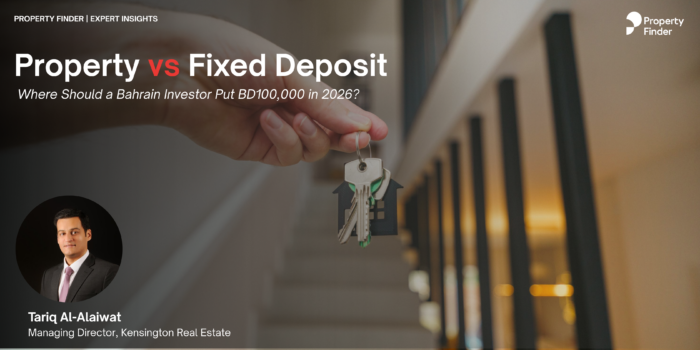
If you had BD100,000 sitting in cash today, what would you do with it? Buy an investment property, put it into a fixed deposit, or simply wait?
It is a question I hear more often now, and I think it is a healthy one. Property investors have traditionally compared one property with another: Amwaj or Juffair, apartment or villa, completed or off-plan. But when cash itself can earn a meaningful return, the comparison changes.
Property is not only competing with other property. It is competing for your capital.
The Comfortable Option: Keep the Money in the Bank
Start with the simpler option. Bahrain dinar fixed-deposit rates vary by bank, amount and term, with some options around the 4-5% range. At 4%, BD100,000 produces about BD4,000 a year.
There is no tenant to find, no maintenance call, no service charge and no vacant month. You also do not have to market an asset when you want your money back. That convenience and liquidity have a value that is easy to overlook.
This is where I think property comparisons can become misleading. A buyer sees a 7% gross rental yield and compares it with a 4% deposit, apparently gaining three percentage points. But once service charges, maintenance and vacancy reduce the property return to, say, 5.5%, the gap is only 1.5%.
Now the real question is whether that extra 1.5% is enough to compensate for everything else you are taking on.
What Are You Being Paid For?
In investing, higher expected return normally comes with higher risk. The extra return from property is not necessarily free money. It is compensation for vacancy, tenant issues, maintenance, market movements, transaction costs and the fact that your capital is much less liquid.
If BD100,000 is tied up in a property, you cannot usually turn it back into BD100,000 tomorrow. You need a buyer, you need to agree on a price and you need to complete the transaction. In some properties that can happen relatively quickly; in others it can take months.
So before I compare the percentages, I ask myself: how much more return do I need before I am willing to give up that liquidity?
So Why Buy Property at All?
Because property offers something a fixed deposit does not: you own an asset whose value can change.
Put BD100,000 into a deposit paying 4% and the return is primarily the interest. With property, you can receive rental income and potentially benefit from an increase in the value of the asset itself.
If a BD100,000 property earns BD5,500 net each year and is eventually worth BD110,000, the overall return looks considerably better than the rental yield alone. But the reverse also needs to be acknowledged. If that property falls to BD90,000, several years of rent may simply make up for the loss in capital value.
I would never treat capital appreciation as something I am automatically entitled to. Property prices do not rise just because we own them.
There is also the question of reinvestment. A fixed deposit gives you a rate for a defined term. When it matures, you have to accept whatever rates are available at that time. Today’s 4% may not be available two years from now. A well-selected property, meanwhile, can continue to generate rent for many years, with both rents and values able to change over time.
The Fun Part – The Power – and Danger – of Leverage
Property also gives investors the ability to use financing. Suppose you buy a BD100,000 property with BD40,000 of your own capital and BD60,000 from the bank. You control a BD100,000 asset with BD40,000 of equity, so an increase in the property’s value can produce a much larger percentage return on your own money.
But leverage does not only magnify gains. If the property falls in value, the debt remains, and financing costs reduce the income you receive.
Used sensibly, leverage is one of the attractions of property investment. Used badly, it can turn an average investment into a burden.
Your Time Horizon Changes the Answer
The next question is simple: when might you need the money?
If there is a realistic chance you will need your BD100,000 next year, property may be the wrong place for it. Transaction costs and the time required to sell make short holding periods difficult.
If the capital can genuinely remain invested for five, ten or fifteen years, the picture changes. You have more time to absorb short-term weakness, recover acquisition costs, collect rent and potentially benefit from long-term appreciation.
This is why there is no universal answer to “property or fixed deposit?” The right decision depends as much on the investor as it does on the asset.
Sometimes the Bank Is the Better Investment
As someone whose business is real estate, I have no difficulty saying that sometimes I would choose the deposit.
If a property is overpriced, produces a weak net return, has expensive service charges and faces a lot of future supply, there is no reason to buy it simply because it is property.
Capital committed to a mediocre investment is capital that is unavailable when a better opportunity appears. There are periods when keeping money liquid, earning a reasonable return and waiting is entirely sensible.
And Sometimes Property Clearly Wins
The calculation changes when you find the right asset at the right price: sustainable tenant demand, a healthy net yield, reasonable ownership costs, manageable competing supply and good resale prospects.
In that situation, giving up some liquidity may be worthwhile, particularly for an investor with a long time horizon who can benefit from both recurring income and potential capital growth.
The important point is that property does not win simply because it is property. The numbers still have to justify the risk.
The Investor’s Test
If I were deciding between BD100,000 in a Bahrain property and BD100,000 in a fixed deposit, I would ask:
- What is the property’s realistic net return after all costs?
- How much more am I earning than I can earn from the lower-risk alternative?
- Am I comfortable having the capital tied up for several years?
- What is my realistic view of the property’s future value, and what supports that view?
- If a better opportunity appeared six months from now, would I regret not having the cash available?
That final question matters. Investment is not just about choosing Property A over Property B. It is about deciding where your capital is best deployed at that particular point in time.
Final Thought
Investors often ask whether property is better than leaving money in the bank. My answer is that it can be, but not at any price.
Property asks more from an investor. It is less liquid, requires more management and carries more uncertainty. In return, it can offer higher income, capital appreciation, leverage or a combination of all three.
If those benefits do not adequately compensate for the extra risk, there is nothing wrong with keeping your money liquid and waiting.
The objective is not to own as much property as possible. It is to allocate capital well. And sometimes the smartest property investment is the one you decide not to make.
By Tariq Alalaiwat
Managing Director, Kensington Real Estate